
Why temperature changes everything
This is chemistry rather than etiquette. When wine is too warm the alcohol evaporates aggressively and goes straight up the nose, covering everything else. You get a burning sensation, the fruit disappears, the tannins feel harder. The bottle you chose carefully becomes tiring on the first sip.
Too cold and the wine closes up. The aromas stay locked in, the mouth registers very little, and the complexity that made the bottle interesting cannot express itself. It tastes like flavoured water. This happens constantly with whites left in the fridge for a whole day, and with reds pushed into the freezer for a quick fix.
The right temperature is the one that lets acidity, tannin, alcohol and aroma talk to each other in balance. There is no universal number, because each style has its own window. Knowing them does not require a precision thermometer, just a few reference points.
Reds: the room temperature myth
Room temperature has done more damage than any sudden chill. The phrase comes from an era when cellars were cool in summer and houses had no central heating. Our average room now sits well above 20 degrees, often 22 to 24 in winter with the radiators on.
A red served at 23 degrees is a red served too warm. Alcohol takes over, tannins turn harsh, and the heat in the throat becomes unpleasant quickly. It shows most on the structured wines: a Barolo or an Amarone at that temperature seems almost coarse, where at 16 to 18 degrees it opens into something else entirely.
The practical rule: full-bodied tannic reds, Barolo, Barbaresco, Brunello, Amarone and Sagrantino, want 16 to 18 degrees. Medium reds, Chianti Classico, Montepulciano d'Abruzzo, Barbera d'Asti, want 14 to 16. Light fruity reds, dry Lambrusco, Frappato, Schiava and some Pinot Noir, are happy below 14 and down to 12.
A bottle kept in a cool cellar is probably already in range. One that has been sitting in a kitchen wants 20 to 30 minutes in the fridge before opening.

Whites: not everything belongs in the fridge all day
A domestic fridge runs between 4 and 7 degrees. A white kept there all day arrives at the table at around 6 degrees, and at that temperature you can barely taste anything. Your first thought is that the wine is anonymous. Leave it in the glass a few minutes and it starts to talk.
Aromatic whites, Gewürztraminer, Moscato, Riesling and Vermentino, show best between 8 and 10 degrees. Too cold and they close, too warm and they turn cloying. Fresh dry whites for the start of an evening, Pinot Grigio, young Soave, Verdicchio and Falanghina, sit well at 10 to 12.
Structured whites, whether fermented or aged in wood, need more room: a serious Chardonnay, Fiano di Avellino, Greco di Tufo, a good Trebbiano d'Abruzzo. Between 12 and 14 degrees they can show both the acidity and the complexity. Served colder they seem to have nothing to say.
The practical version: take a white out of the fridge 15 to 20 minutes before opening if it has been in there all day, or put it in the fridge only a couple of hours ahead if it has been somewhere cooler.
Sparkling: cold helps, up to a point
Sparkling wine has a reputation for wanting to be very cold, and cold does keep the acidity alive and hold the pressure. There is still a real difference between serving at 6 degrees and at 10 to 12, and it is often the difference between an anonymous fizz and something that surprises you.
Quality classic-method sparkling, Franciacorta, Trento DOC and Alta Langa, has complexity that excessive cold smothers. At 8 to 10 degrees you get the secondary aromas from the time on the yeasts: brioche, toasted hazelnut, a buttery edge. The bead is fine and persistent and the mouth is creamy. At 5 or 6 degrees the same wine is simply cold and fizzy.
Tank-method sparkling that trades on freshness, Prosecco and Asti, takes more cold happily, 6 to 8 degrees, because immediacy is the point.
An ice bucket is the ally here, keeping temperature steady through a meal rather than freezing the bottle before it is poured.
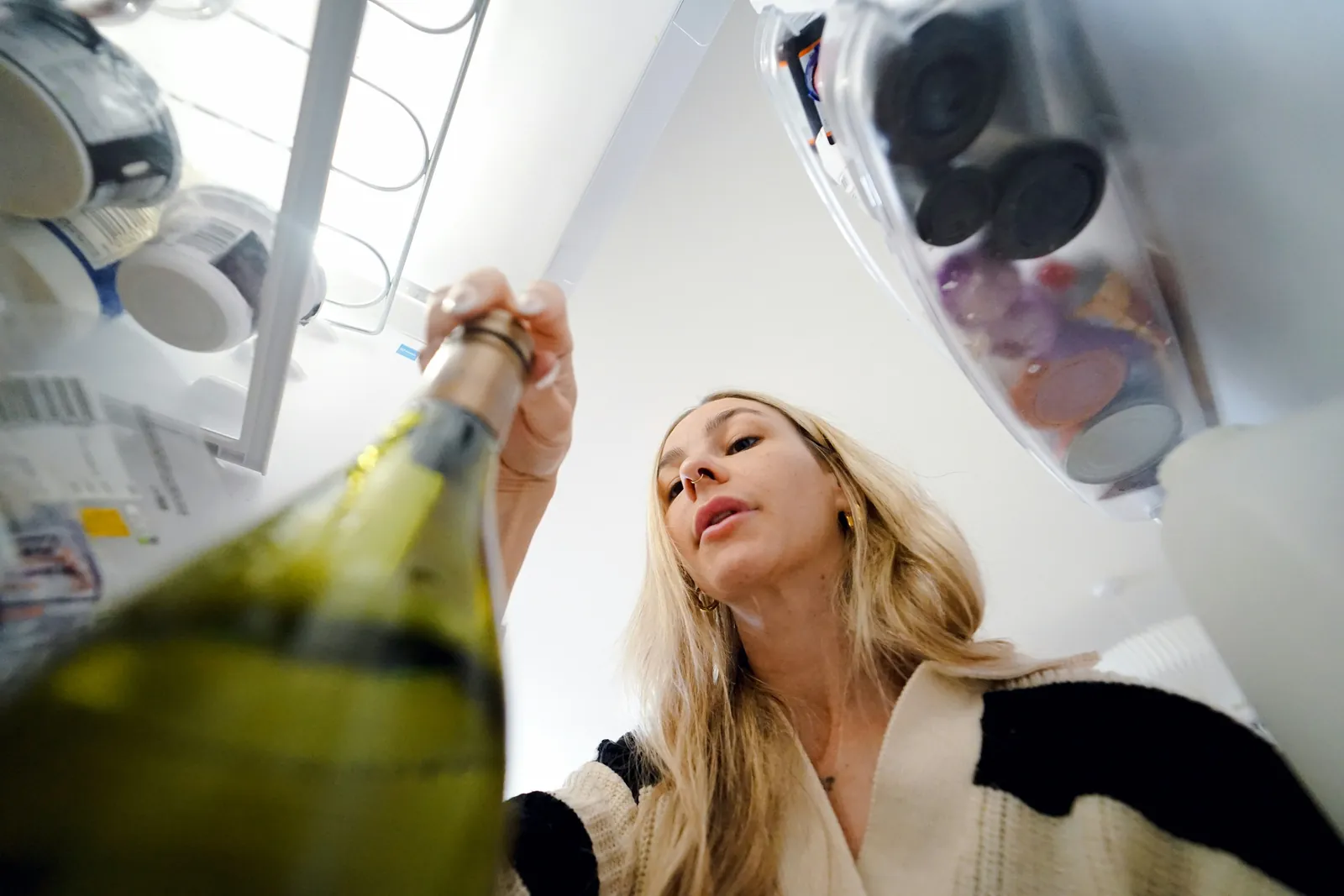
Rosé, orange and low-intervention wines
Rosé is usually treated as a summer white and forgotten in the fridge. Many Italian rosés with real character, from Salento, Cerasuolo d'Abruzzo, Chiaretto from Lake Garda, have structure that wants more room than a light white. Between 10 and 12 degrees they show both the freshness and the darker fruit underneath.
Orange wine is its own case. White grapes macerated on their skins have real tannin, pronounced acidity and often a controlled oxidative character. Serving them as cold as a normal white flattens them completely. Treat them as light reds, 13 to 16 degrees.
Low-intervention wines in general react strongly to temperature. They often carry a volatile, slightly wild complexity that hides when cold and can turn unpleasant when too warm. The useful window sits a couple of degrees above the conventional equivalent of the same style.
Sweet and fortified wines: cold but not frozen
Sugar concentration changes how temperature reads. Too cold and the sweetness flattens into something heavy and uniform. Too warm and it turns cloying while the alcohol, often high in dried-grape wines, takes up too much space.
Light fresh sweet wines, Moscato d'Asti and Brachetto d'Acqui, sit at 6 to 8 degrees. Structured sweet wines, Passito di Pantelleria, Recioto della Valpolicella and Vin Santo, want a few degrees more, 10 to 14, to show what the drying of the grapes built. Vin Santo is worth explaining if you have not met it: Tuscan, made from grapes dried on racks for months, traditionally drunk with hard almond biscuits dipped straight into the glass.
Fortified wines, Marsala and Vernaccia di Oristano among them, carry serious alcohol. Between 12 and 16 degrees, depending on style, they show ripe fruit, spice and oxidative complexity without the alcohol dominating.
One detail that matters: the small glasses used for dessert wine warm quickly in the hand. Pour a little at a time and hold the stem.
Cooling and warming a bottle without damaging it
The freezer is the enemy. Not because it chills badly, it chills far too well, but because it does so unevenly, and a forgotten bottle can push its cork out or crack. If you use it, set a timer for 15 to 20 minutes and stay in the room.
The best fast method is a bucket of ice and cold water in equal parts. The water carries the cold evenly across the whole surface of the glass, and in 15 to 20 minutes it takes a bottle from room temperature to around 10 to 12 degrees.
To warm a wine that came from the fridge, never use hot water on the glass and never a microwave. Pour it and hold the glass for a few minutes, or decant it: a decanter both aerates and brings the wine up to temperature at a sensible speed.
A clip-on wine thermometer costs very little and removes the guesswork entirely.
The wine warms up in the glass
We concentrate on the temperature at opening and forget that wine warms quickly once poured. A red served at 16 degrees in a room at 22 is already at 18 or 19 after ten minutes, especially in a large glass held by the bowl instead of the stem.
Two consequences. First, it pays to serve slightly below the ideal and let the wine climb into its window. A Barolo opened at 15 degrees reaches its 17 or 18 in the time it takes to go round the table once. Second, do not overfill the glass: pour less and pour more often, so what is in the glass is always in range.
In summer the effect is amplified. A terrace at 28 degrees heats a bottle far more aggressively than a dining room. We keep bottles in the bucket in summer even for light reds, taking them out a few minutes before pouring.
Thick glasses warm more slowly than thin ones. That is not an argument for worse glassware, since thin glass is better for what you taste, but it explains why the last mouthful in a heavy tumbler feels different.
Quick reference
Each wine has its window and you memorise them without trying after a while. Until then, a list saves reasoning from scratch every time:
- Sweet sparkling and Prosecco: 6-8 degrees
- Quality classic-method sparkling (Franciacorta, Trento DOC): 8-10 degrees
- Light fresh whites (Pinot Grigio, young Soave, Falanghina): 10-12 degrees
- Aromatic whites (Gewürztraminer, Riesling, Vermentino): 8-10 degrees
- Structured and wood-aged whites (serious Chardonnay, Fiano, Greco di Tufo): 12-14 degrees
- Rosé with structure: 10-12 degrees
- Orange wine: 13-16 degrees
- Light reds (Frappato, Schiava, dry Lambrusco): 12-14 degrees
- Medium reds (Chianti Classico, Barbera, Montepulciano): 14-16 degrees
- Full-bodied tannic reds (Barolo, Brunello, Amarone, Sagrantino): 16-18 degrees
- Light sweet wines (Moscato d'Asti, Brachetto): 6-8 degrees
- Structured sweet and dried-grape wines: 10-14 degrees
- Fortified wines: 12-16 degrees
These are starting points rather than doctrine. Your room, your glasses and your own palate move them.
The mistakes that spoil a good bottle
The first and most common has already been said: the fridge for everything. A red pulled out five minutes before dinner, a structured white left at 5 degrees for hours, a dessert wine served like a summer Pinot Grigio.
The second is where the bottle waits. Next to the hob, on top of the fridge where the motor heat rises, on a windowsill in direct sun. These raise the temperature silently, and then you open the bottle expecting something and find it tired. That is not the vintage's fault.
The third is never checking. Most people carry a bottle to the table without touching it. Put a hand on the glass for a few seconds: uncomfortably cold to hold means the wine is too cold, lukewarm means too warm. No thermometer required.
The last is not saying anything in a restaurant. You are entitled to ask for a bottle to be brought to a different temperature, and a good sommelier will be pleased rather than offended that you know what you want.
Domande frequenti
Can I put red wine in the fridge to cool it quickly?
Yes, keeping an eye on it. 20 to 30 minutes drops the temperature a few degrees without over-chilling. The freezer is faster and riskier. A bucket of ice and water is the most controllable method.
Do low-intervention wines need a different temperature?
Usually one or two degrees warmer than the conventional equivalent. They often carry aromatic complexity that excessive cold silences. Treat them as their style suggests, with a little margin towards warm.
How do I judge temperature without a thermometer?
Put your hand on the glass for a few seconds. If the bottle is uncomfortable to hold because of the cold, the wine is too cold. If it feels lukewarm, it is too warm. For whites you want cool but not icy; for reds barely cool, never body temperature.
Why does wine always taste better in a restaurant?
Often it is precisely the serving temperature. A restaurant with a decent cellar stores bottles at a steady temperature and brings them out in range. At home we pour them too cold from the fridge or too warm from the kitchen.
Are Prosecco and Franciacorta served at the same temperature?
No. Prosecco and fruity tank-method sparkling are better colder, 6 to 8 degrees. Franciacorta and other quality classic-method wines show their complexity better at 8 to 10. A couple of degrees changes those wines noticeably.
Can I buy these wines if I am not in Italy?
Prosecco, Chianti, Soave and Amarone are exported everywhere. Franciacorta, Trento DOC and the dried-grape sweet wines need a specialist, and Vernaccia di Oristano is genuinely hard to find outside Sardinia. The shop linked on this page ships within Italy only, so if you are ordering from outside Italy it cannot deliver to you.